




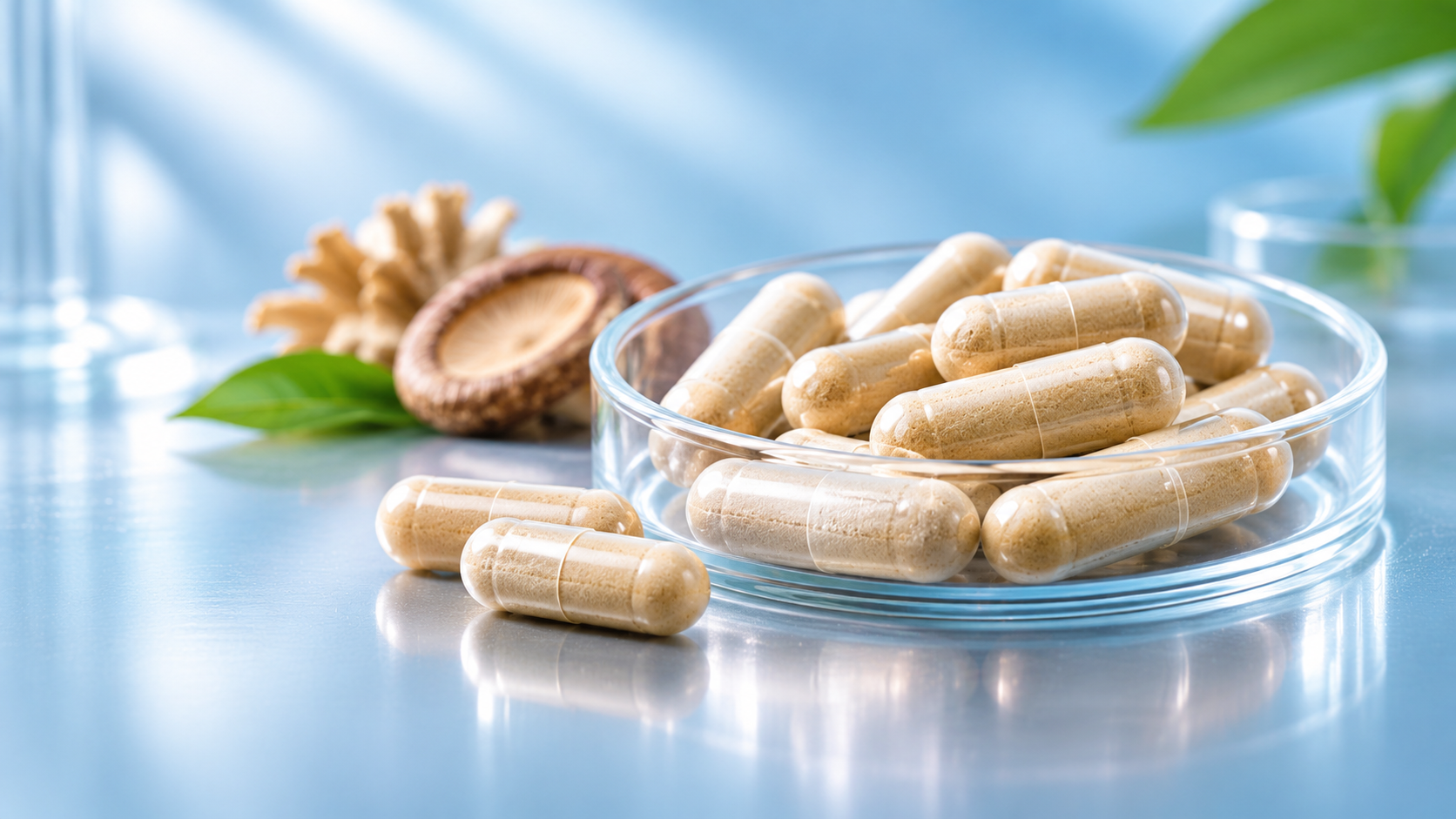

The French Agency for Food, Environmental and Occupational Health & Safety (ANSES) has published a new scientific opinion on the side effects associated with shiitake, reishi and maitake. It highlights the need to identify mushroom species reliably, to characterise extracts precisely and to fill data gaps on safety, including possible interactions with medicines.
A new opinion on popular mushroom supplements
The French Agency for Food, Environmental and Occupational Health & Safety (ANSES) has published a new scientific opinion on the side effects associated with the consumption of mushrooms such as shiitake, reishi and maitake. Its findings concern both how these ingredients are identified and characterised, and what is known about their safety. For operators in the nutraceuticals sector, they are a useful reminder of what authorities expect from the evidence behind a food supplement.
What the literature and nutrivigilance data show
The review of the scientific literature reports several cases of hypereosinophilia, cutaneous allergic reactions and digestive discomfort with shiitake. For reishi, ANSES points to an existing risk of hepatotoxicity and haematological toxicity, together with a lack of data on genotoxicity. In France, 38 cases were reported to the nutrivigilance scheme between 2009 and 2024. Nutrivigilance, the monitoring of undesirable effects of food supplements, follows the same logic as pharmacovigilance and drug safety.
Identification and characterisation: the weak link
ANSES stresses the need for sequencing of the Internal Transcribed Spacer (ITS), the reference method for mushroom identification, to avoid confusion between species. It also notes that extracts are often not precisely characterised, both in the scientific literature and in marketed products. Without this information, safety data are hard to compare and to apply to a given supplement.
Interactions and advice for consumers
The risk of drug interactions cannot be excluded between maitake and anticoagulant treatments, and between reishi and anticoagulant, hypoglycaemic, lipid-lowering, anticancer and immunosuppressive treatments. Additional studies and label warnings in food supplements may be needed to guarantee consumer safety.
ANSES advises consumers to consult a healthcare practitioner and to avoid long-term consumption of supplements containing shiitake, reishi or maitake. It also suggests not combining several food supplements at the same time and favouring the best-controlled distribution channels.
For a wider view of the regulatory landscape, read our article on the six regulatory points requiring attention from food supplement operators.
Read the full ANSES opinion (original document in French): https://www.anses.fr/system/files/NUT-2022-AUTO-0158.pdf
Key takeaways
- Identification matters. ITS sequencing is the reference method to confirm the species and avoid confusion between mushrooms.
- Safety signals exist. The literature reports hypereosinophilia, skin allergic reactions and digestive discomfort with shiitake, and a risk of hepatotoxicity and haematological toxicity with reishi.
- Data gaps remain. Genotoxicity data on reishi are lacking, and extracts are rarely characterised precisely.
- Interactions cannot be excluded. Maitake and reishi may interact with several treatments, which may call for further studies and label warnings.
How PLG can help
PLG supports companies in Consumer Health with regulatory affairs, scientific and medical affairs for the development of ingredients, food supplements, FSMP, cosmetics and medical devices. Let’s discuss your next innovation.
DISCOVER OUR CONSUMER HEALTH SERVICES
Want to discuss your project? Get in touch with our experts.

About the Author
Véronique Traynard (PhD) is Senior scientific and clinical project expert – CHC at ProductLife Group, specialised in food supplements, FSMP, nutrition and cosmetics, from R&D and clinical research to regulatory dossiers and scientific communication. She lectures on food supplements at AgroSup Dijon.