





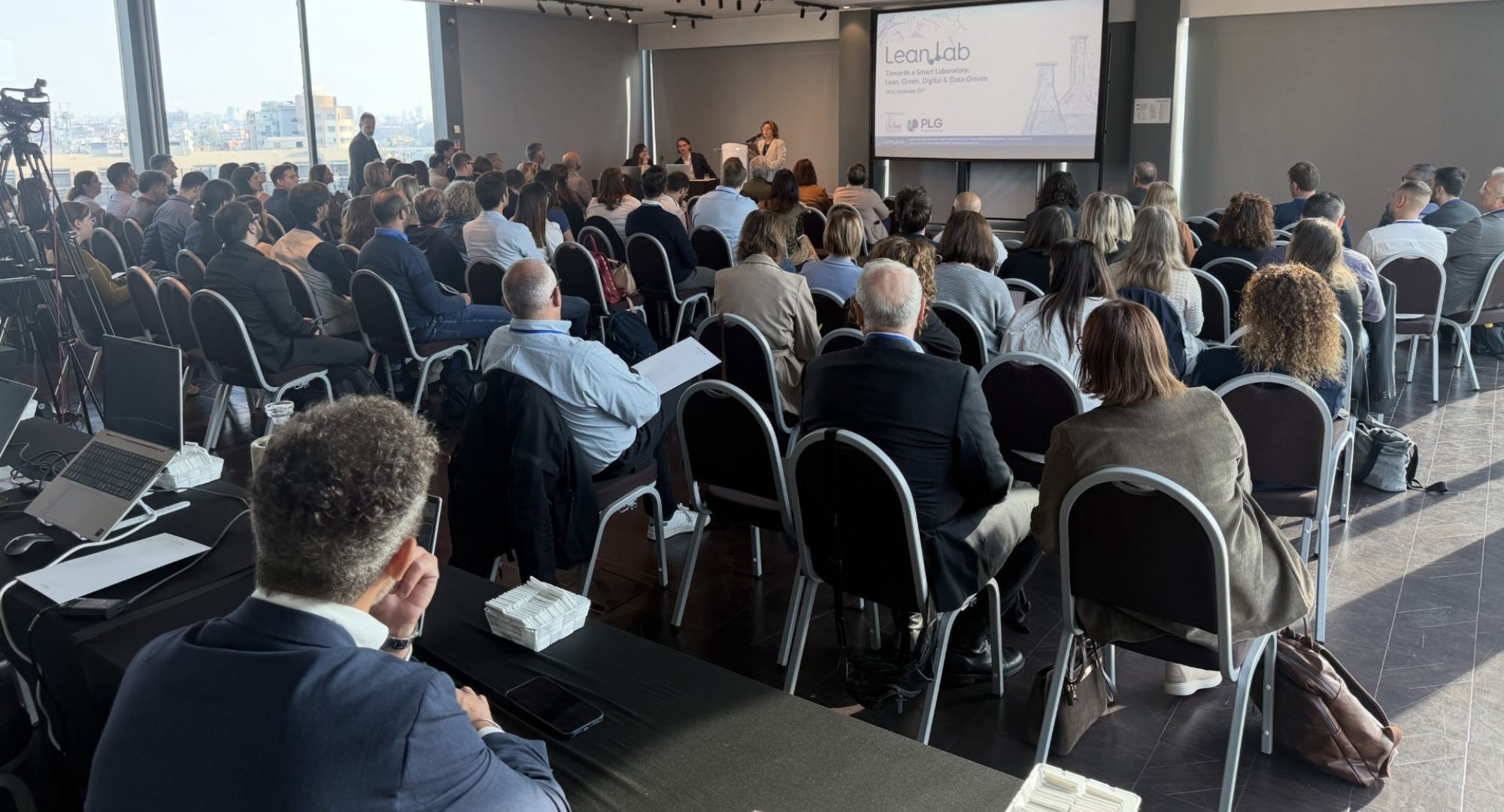

On 29 September 2026, Lean Lab, the LifeBee format that has brought Life Sciences laboratory professionals together since 2009, held its sixteenth edition in Milan. It was the first with an international line-up. Speakers from AbbVie, Merck, Diasorin, Johnson & Johnson, Veeva Systems, Omron and PLG arrived at the same conclusion: a smart laboratory is not a technology project.
120 laboratory professionals from 45 Life Sciences companies met at the Duo Milan Porta Nuova Hotel. The theme was "Towards a Smart Laboratory: Lean, Green, Digital & Data-Driven". The programme moved from quality control floors in France and the United States to Italian development sites, from LIMS go-lives to fluorescence-based colony counting, from citizen developers to a global operating model.
One thread ran through every talk. Technology accelerates the laboratory, but people, processes and trusted data decide whether the change lasts.
Sixteen editions, one community, now international
Lean Lab was launched in 2009 by Raffaella Vaiani, CEO of LifeBee, a PLG company, as a format dedicated to Life Sciences laboratories and the people who run them. Sixteen editions later, it counts 132 speakers, more than 1,400 participants, 130 hours of training, 74 case studies and 14 editions of its industry survey.
The format has always followed a simple rule: real experiences, including what did not work, shared by the people who live the laboratory every day. Each edition combines case studies from industry, the results of the annual Lean Lab Survey and a round table where pharmaceutical companies, technology providers and consultants sit at the same table.
Lean Lab 2025 closed with a promise: next year, the format would go international. This edition delivered on it, with speakers from four countries, several of whom travelled from France and the United States to Milan. About one participant in five had already attended a past edition.
The audience reflected the evolution of the laboratory itself. Quality control professionals made up 48% of the room, and most of the others came from digital and IT management, a group that grew compared with 2025.
The day was chaired by Marco Luchini, Manufacturing & Laboratory Manager at LifeBee, a PLG company, with co-chair Maria Teresa D'Alise, Business Process Integration & Digital Strategy Manager at AbbVie's Martillac site. Her role brought what the organisers called "the voice of the customer" onto the stage. The chairs framed the programme through eight lenses on the smart laboratory, grouped in three families:
- The foundations: people and process.
- The way we work: lean, green and compliance, with data integrity and GxP built in by design.
- The accelerators: digitalisation, robotics and AI.
As D'Alise put it, the accelerators attract most of the attention, but they only deliver when the foundations are solid.
From lean foundations to the intelligent laboratory
Raffaella Vaiani, CEO of LifeBee, a PLG company, who launched Lean Lab in 2009, opened the day by calling this edition a milestone: the first international Lean Lab, bringing together experiences and best practices from different countries and organisations. Marco Luchini then took the room back to 2009, when WhatsApp and Bitcoin were born and AI was rarely discussed, to ask what the next seventeen years will bring to the laboratory, or even sooner. A live poll asked participants to describe their lab in five to ten years: autonomous, paperless, green, human-centred or predictive.
Beyond Lean: building the intelligent laboratory
Raffaella Vaiani, CEO of LifeBee and Service Area Lead for Product Compliance Digitalization at PLG, opened the content programme with a question: not "how do we make processes more efficient?" but "how do we make laboratories smarter?". She described four generations of laboratory maturity, from the traditional paper-based lab to the lean lab, the digital lab and, now, the intelligent lab.
In her view, lean remains essential, but it is now the foundation rather than the destination. The next step is not another system. It is the orchestration of data across instruments, LIMS, ELN, CDS, MES and QMS, supported by a clear data strategy and governed agentic AI. Her six-step roadmap runs from digitise to connect, orchestrate, govern, intelligence and, finally, "lab in the loop": a self-learning laboratory where every outcome improves the next decision. Sustainability, she argued, becomes a consequence of operational intelligence rather than a separate objective.
AbbVie: from acquisition to integration without breaking flow
Daniel Moreira, LIMS Administrator and QC Digital Tools Lead, and Aurelien Broly, QC Supervisor, told the story of AbbVie's Martillac site in France. The site joined AbbVie in August 2025 and went live on the company's LIMS five months later, in January 2026, with a second phase live in August 2026. Their approach, called FAST (Flawless Action for a Successful Transition), rested on one principle: to be one company, you need one platform, so you adapt the process rather than the system.
Martillac is a four-building biotech campus where people, samples and materials move every day between QC, manufacturing, warehouse and development. Its QC runs five laboratories, with about 70 people, 300 instruments and around 20,000 tests a year. "On a multi-site campus like ours, digital connectivity is just as important as physical connectivity," Broly said. The team chose a phased approach rather than a big-bang go-live, and treated integration as a learning curve in four stages: discover, build, adopt and master.
The results so far include about 50,000 lines of master data configured and verified, 127 people trained, three teams onboarded and more than 1,200 environmental monitoring sampling points managed in the LIMS, with all related paper records replaced. Their closing message: "Tomorrow's QC will be more automated. Its impact will still be human."
The next chapter is a connected, automated and augmented QC. Robots for bioassays and ELISA are already being introduced, and AI should help move quality management from reactive to predictive, while people remain accountable for decisions. In the Q&A, Moreira shared a lesson for anyone changing systems: two LIMS may share the same objectives and still affect your processes more than you think, so test with users and sit down with them. Broly added that compliance became easier to demonstrate. During a recent inspection, scanning a barcode replaced the search for paper records, and the questions moved to how people had been trained.
Merck: unlocking citizen development in pharma
Andrea Taiani, Business Excellence Associate Director, and Alessandro Sordi, Digital & Data Analytics Expert, both from Merck's Healthcare business in Italy, presented the citizen development programme launched in 2025 at the Guidonia site near Rome. The starting point was a familiar paradox: digital tools built for the lab by IT often see low adoption, because only a few super-users really know them. Citizen developers, process experts who use approved low-code and no-code tools, start from the business need instead.
The real challenge is governance. Too little, and tools multiply without control; too much, and people walk away. Merck's sweet spot combines a risk-based GxP assessment, a central repository so that no lab reinvents the wheel, and a simple rule: "you build it, you own it", from documentation and business continuity to retiring applications that are no longer used. After all, Taiani reminded the room, Merck's business is delivering medicines to patients, not building apps.
The use cases were deliberately practical: a digital gemba walk app that tracks every action to its owner, a dashboard that makes the site's improvement ideas visible, a view of instrument utilisation to find laboratory bottlenecks, and an AI assistant that guides colleagues through the change control process. Born locally, the approach is now being shared as a best practice across Merck's network.
Merck Life Science: three ways to automate colony counting
Federica Pellegrini, Field Sales Specialist BioMonitoring at Merck Life Science, took the audience inside a sterile QC microbiology lab. Using an illustrative case modelled on high-volume sterile sites, she compared three ways to read environmental monitoring plates automatically: end-point reading, kinetic reading and kinetic reading with fluorescence, which detects micro-colonies of about 100 cells instead of the 10 million needed to see one by eye.
Her central advice applies well beyond microbiology: start from the decision, not the instrument. In the case presented, automation was focused on the grade A/B and personnel plates that hold up batch release, bringing negative results from 5–7 days to about three. The LIMS connection, she stressed, is half of the value.
Diasorin: one team, one vision
Doug Wendt, Senior Director, Industrial Operations and Site Lead at Diasorin in Stillwater, in the United States, shared how a network of successful sites became a globally aligned operating model through the OneOps programme. The starting point was not poor performance: "good sites don't automatically create a great network". Similar products were made differently, and KPIs with the same name were measured in different ways.
Harmonising governance, processes, metrics and escalation paths, supported by a common LIMS, was only half of the work. The biggest challenge, Wendt said, was people: uncertainty, fear of losing autonomy and change fatigue. The team spent as much time building trust as building processes. Results reported for 2025 include an 8% gain in productivity and an 85% reduction in back orders, with lower lead times and scrap.
A new name for PLG
Before lunch, James Burt, CEO of ProductLife Group, took the stage for a moment not listed in the agenda. Lean Lab was the setting for the reveal of PLG's new brand and its positioning, "Advanced Intelligence for Life Sciences": 26 specialist businesses, including LifeBee, coming together under one name. "Automation accelerates the expert. It never replaces them," he said, a message that echoed the whole day.
Predictive quality, the industry benchmark and the round table
Johnson & Johnson: from digital lab to predictive quality
Silvia Riccelli, QC Technology & Innovation Senior Supervisor, and Valentina Paglia, Associate Scientist QC T&I, at Johnson & Johnson Innovative Medicine, opened the afternoon. Their message: paperless is only the beginning. Once laboratory data is digital, AI can start to predict quality instead of just checking it.
The Lean Lab Survey: data and people
Giulia Petrachi, Senior Consultant at LifeBee, a PLG company, presented the results of the fourteenth Lean Lab Survey. It gathered 102 contributors from analytical, research and quality control laboratories, three in four of them from multinational companies. The picture is of an industry that knows where it wants to go but has not arrived yet:
- Digital lab: paper is still the most common format in 12 of 13 laboratory processes. Release of lots is the only one where information systems lead, at 41%. Investigations, OOS and OOT remain 60% on paper.
- Lean lab: lean is widespread, mainly in QC and production, and 94% of respondents cite efficiency as its main benefit. Yet resistance to change is still the top barrier, and almost half of companies have trained fewer than 20% of their staff.
- Green lab: a younger path. Around half of laboratories have not yet started a sustainability programme, but among those that have, certification is now the most common route.
- KPIs: laboratories mostly want to measure time. Almost 78% say the hardest part is collecting accurate data, and more than a third still collect it by hand.
- AI and robotics: both at an early stage. Data analysis is the top expectation for AI, and sample preparation for robotics. High cost is the main barrier.
The common thread, Petrachi concluded, is the same two words: data and people.
Round table: Life Science laboratory new trends
The day ended with a round table moderated by Marco Luchini, with Justin Lavimodiere joining remotely from Veeva. It brought every actor of the laboratory ecosystem around one table:
The discussion ran in three rounds. The first, "AI and robotics: promise vs. reality", started from the ISPE Pharma 4.0 survey, which Teresa Minero has led for ten years, to assess how mature AI adoption really is across the industry. The panel then asked whether AI's biggest impact will come from efficiency gains or from better scientific decisions, which use cases will matter in the next three to five years, and what still holds robotics back in the lab. Diasorin brought the view from implementation: automation is never a machine you simply plug in, but a redesign of spaces, flows and end-to-end integration.
The second round, "People, organisation and data: making it stick", turned to the skills and mindset the laboratory workforce will need, the balance between autonomous workflows and human expertise, and the most common mistakes when new technologies enter the lab. Diasorin offered a rare double perspective: it runs its own laboratories and designs automated diagnostic platforms used by clinical labs worldwide. A closing lightning round asked each panellist for one piece of advice to laboratory leaders.
Teresa Minero summed up one of the strongest messages of the day: start from the value, with the end in mind. Technology is only an enabler; culture makes the difference.
What the day leaves behind
Closing the edition, Marco Luchini and Maria Teresa D'Alise brought the talks together in one idea: a smart lab is not a technology project. It is lean processes, green choices and trusted data, driven by people.
The cases from AbbVie, Merck, Diasorin and Johnson & Johnson showed the same pattern from different angles. Integration works when the process adapts to one platform. Digital tools spread when process experts own them. Automation pays off where someone is waiting for the result. Global alignment starts with trust. The survey confirmed it with data: the barriers are less about tools than about measurement, skills and change.
The international format also proved its point. Bringing together voices from Italy, France and the United States, and from pharma, diagnostics, software, robotics and consulting, turned individual experiences into a shared view of where Life Sciences laboratories are heading.
The journey continues with Lean Lab 2027, the seventeenth edition. Date and venue will be announced soon. Participants can request their certificate of participation and conference papers at marketing@lifebee.it.
Lean Lab 2026 was organised by PLG and LifeBee, with the support of My Green Lab and media partners NCF – Notiziario Chimico Farmaceutico and AboutPharma.