





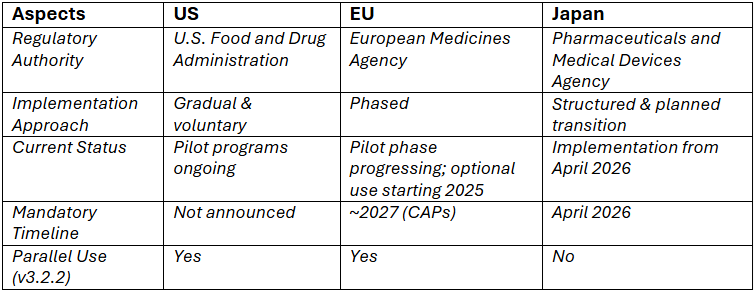

The electronic Common Technical Document (eCTD) has played a pivotal role in advancing the digitalization and standardization of regulatory submissions. With the introduction of eCTD v4.0, the clinical development industry is transitioning toward a more structured, data-driven model designed to enhance efficiency through improved document reuse, greater data granularity, and more robust lifecycle management. However, the global adoption of eCTD v4.0 remains uneven. Regulatory authorities across key regions, including the United States, Europe, and Japan, are progressing at varying paces, each following distinct timelines, implementation strategies, and levels of preparedness.
Global Overview of eCTD v4.0 Adoption Although the standard was finalized by the International Council for Harmonization (ICH), its implementation has been gradual. Adoption is currently in a hybrid phase, where:
 Key Challenges Impacting Global Adoption Despite clear benefits, several challenges are influencing the pace of adoption:
- eCTD v3.2.2 remains the dominant and fully operational standard worldwide
- eCTD v4.0 is being introduced through pilot programs, voluntary submissions, or phased implementations
- Mandatory timelines vary significantly by region
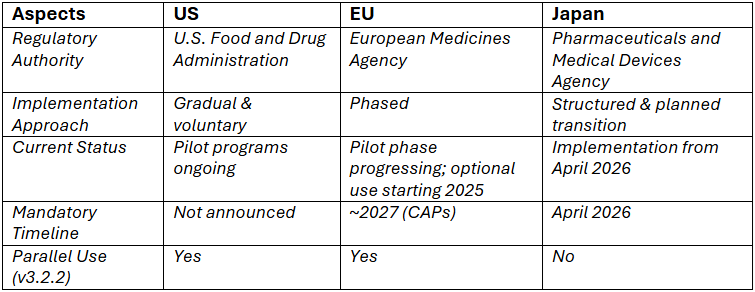
- Since September 16, 2024, the FDA has begun accepting voluntary eCTD v4.0 submissions for new applications
- eCTD v3.2.2 continues to be the primary operational standard
- No official mandatory deadline has been announced for the transition to eCTD v4.0
- Pilot programs and preparatory activities have been completed
- Mandatory implementation is expected from April 2026
- Canada and Australia: Planning voluntary adoption around 2026, with mandatory timelines anticipated later
- Brazil (ANVISA) and other emerging markets: Engaged in pilot programs or exploratory phases, with some regions still awaiting clearer implementation roadmaps
Key Challenges Impacting Global Adoption Despite clear benefits, several challenges are influencing the pace of adoption:
- Technical complexity of transitioning from document-based to data-driven submissions
- Training and upskilling needs for regulatory and publishing teams
- Lack of synchronized global timelines, leading to prolonged hybrid submission environments